Cold Boots, Clear Skies: The Case for Hiking Switzerland in Winter
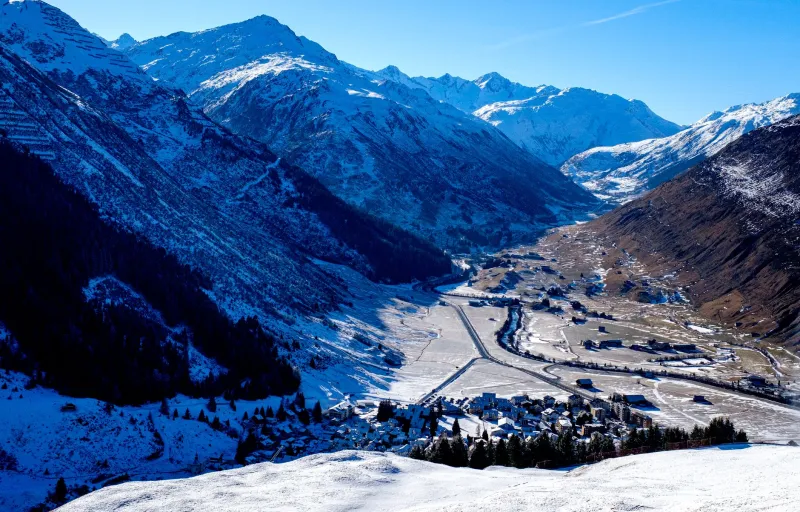
Here's something most American travelers never consider: the Swiss don't stop hiking when the temperature drops. They adjust. They layer up, swap out their trail runners for something with a little more grip, and head out into valleys that the summer crowds have completely abandoned. The result? Some of the most memorable mountain experiences you can have without booking six months in advance or elbowing past tour groups at every viewpoint.
If your mental image of Switzerland is all cable cars, wildflowers, and July sunshine, it's time to recalibrate.
Why Winter Is the Locals' Best-Kept Secret
Walk through any Swiss village in January or February and you'll notice something: the trails aren't empty. They're just quieter. Families are out on Sunday afternoon walks. Retirees are moving at a steady pace through pine forests dusted with fresh snow. Dogs are absolutely losing their minds over every snowdrift.
The truth is that Switzerland's lower elevation trail network — think valleys like the Lauterbrunnen, Engadin, and the Bernese Oberland foothills — stays accessible through most of the winter without requiring crampons, ice axes, or any technical mountaineering background. These aren't extreme winter expeditions. They're the same trails you'd hike in September, just quieter, colder, and honestly more dramatic in a lot of ways.
The light in winter does something to the Alps that summer just can't replicate. Low-angle sun hits snow-covered peaks and turns them into something that looks almost artificially beautiful, like a screensaver you'd dismiss as unrealistic. Except you're standing in it.
Trails Worth Planning Around
The Aletsch Forest Path near Bettmeralp is a solid starting point for first-time winter hikers in Switzerland. The trail runs through one of the oldest protected forest areas in the Alps, with views across to the Aletsch Glacier — the longest glacier in the Alps — that are somehow even more striking when framed by bare larch trees and snow. The path itself is well-marked and maintained, and the elevation stays reasonable enough that you're not fighting altitude on top of cold temperatures.
The Engadin Valley trails around Zuoz and S-chanf offer a different flavor entirely. This region in Graubünden canton has a quieter, more understated character than the Bernese Oberland, and winter strips it back even further. Frozen lakes, Roman-era village architecture, and a trail system that connects small communities make this an ideal place for multi-hour walks that feel more like exploration than exercise.
Around Grindelwald, the lower valley paths stay navigable through winter and give you views of the Eiger's north face without requiring you to ride a gondola to get them. There's something satisfying about earning that perspective on foot, especially when the mountain is plastered in winter conditions and you're standing at the bottom in your hiking boots, coffee in hand.
The Gear Difference That Actually Matters
American hikers often assume that winter hiking requires a complete gear overhaul. It doesn't — but a few specific adjustments make a real difference.
Microspikes are non-negotiable. Not crampons, not snowshoes for most lower-valley trails — just a pair of lightweight traction devices that slip over your regular hiking boots. They weigh almost nothing, cost around $50-70, and transform icy patches from ankle-twisting hazards into non-events. If you buy nothing else before a Swiss winter hike, buy these.
Waterproof footwear matters more than insulation. Swiss valley trails in winter are often wet rather than deeply snowy. You'll walk through slush, cross streams with reduced but still-present flow, and deal with snowmelt on south-facing slopes. A waterproof hiking boot rated for three-season use handles this better than heavily insulated winter boots that weren't designed for actual trail movement.
Layering for variable conditions. Valleys in Switzerland can warm up significantly by midday even in January, especially on clear days. Starting a hike in full winter kit and then sweating through a sunny afternoon stretch is a real experience. The Swiss approach — and it's worth copying — is to start slightly underdressed and carry layers rather than wear them. A merino wool base, a fleece mid-layer, and a wind-resistant shell covers most conditions without turning you into a walking sleeping bag.
Trekking poles. More useful in winter than summer on most trails. Descending icy or compacted snow sections with poles is dramatically more comfortable and confident than without them.
Timing It Like a Swiss Local
Swiss hikers who know their trails tend to avoid two specific windows: the Christmas-New Year holiday period and any weekend that coincides with school breaks. During those stretches, even the winter trails see elevated traffic — mostly domestic tourism and visitors from neighboring Germany and Austria.
The sweet spot is mid-January through late February on weekdays. Trail conditions are typically stable by then, the holiday crowds have cleared, and the days are starting to lengthen again after the solstice. You'll find huts and valley restaurants operating on reduced but reliable winter schedules, which means you can still stop for a bowl of rösti or a cup of something hot without planning it like a military operation.
Early March introduces the risk of spring conditions at lower elevations — meaning slush and mud — while upper trails remain solidly winter. It's a transitional window that requires a bit more research but can deliver genuinely extraordinary days when conditions align.
The Mindset Shift
There's a tendency among American hikers to approach Switzerland as a checklist destination — Matterhorn view, check; Jungfraujoch, check; lake reflection photo, check. Winter hiking doesn't fit that framework neatly, and that's exactly the point.
When you're moving through a snow-quiet valley with no one else on the trail, stopping to watch light shift across a frozen meadow, or sitting on a log eating your packed lunch while a raven circles overhead — that's not a checkbox moment. That's the actual experience of being in a place.
Swiss locals understand this intuitively. The mountains aren't a backdrop for their Instagram. They're just where you go when you want to clear your head, feel small in a good way, and come home tired enough to sleep well.
You don't need perfect weather, peak wildflower season, or a gondola ticket to access that. You just need the right boots, a trail map, and the willingness to go when everyone else has already gone home.
That's the winter hiking hack. It's not technical. It's just a decision.